Back
Buy Proxies with Crypto in 2026: USDT, BTC and ETH from $0.10
Short answer: yes, you can buy residential, mobile, ISP and IPv4 proxies with cryptocurrency, and for most of the world it is now the easier payment route rather than the exotic one. On ProxyUniverse the minimum top-up is $0.10, crediting is automatic, and you can pay either on the site or without ever leaving Telegram.

Why crypto became the default way to buy proxies
Five years ago paying for proxies with coins was a privacy preference. In 2026 it is frequently the only thing that works, for four unglamorous reasons.
Cards get declined by the bank, not the shop. Proxy and VPN merchants sit in a payment category that many issuers in Nigeria, Bangladesh, Pakistan, Egypt and Indonesia simply refuse. The purchase fails before the seller ever sees it.
No international card at all. A large share of proxy buyers have a local debit card that does not work for cross-border payments, and no realistic path to getting one.
Currency controls and sanctions. In Iran, Venezuela and several neighbouring markets, sending a few dollars abroad through the banking system is genuinely difficult. Sending USDT takes thirty seconds.
Nobody wants a proxy purchase on a bank statement. Not because it is illicit, but because a card payment ties your identity to your infrastructure, which is the opposite of the point.
Which coin should you actually use
Bitcoin is the famous one, but it is rarely the right one for a small purchase. The practical ranking for buying proxies:
USDT is the correct default. It is a stablecoin, so $12 stays $12 between the moment you send it and the moment it credits. No price movement, no "I sent enough but it arrived short".
Bitcoin works, but the price moves while the transaction confirms and the network fee is unpredictable. Fine for larger top-ups, wasteful for $10.
Ethereum works, and the ERC-20 network fee can genuinely exceed the value of a small order. Use it only if it is what you already hold.
USDT wins for one boring reason: a stable unit and a choice of cheap networks.
The network matters more than the coin
This is the part that costs people real money. USDT exists on several blockchains, and the transfer fee differs by two orders of magnitude between them. Same coin, same balance, wildly different cost to move it.
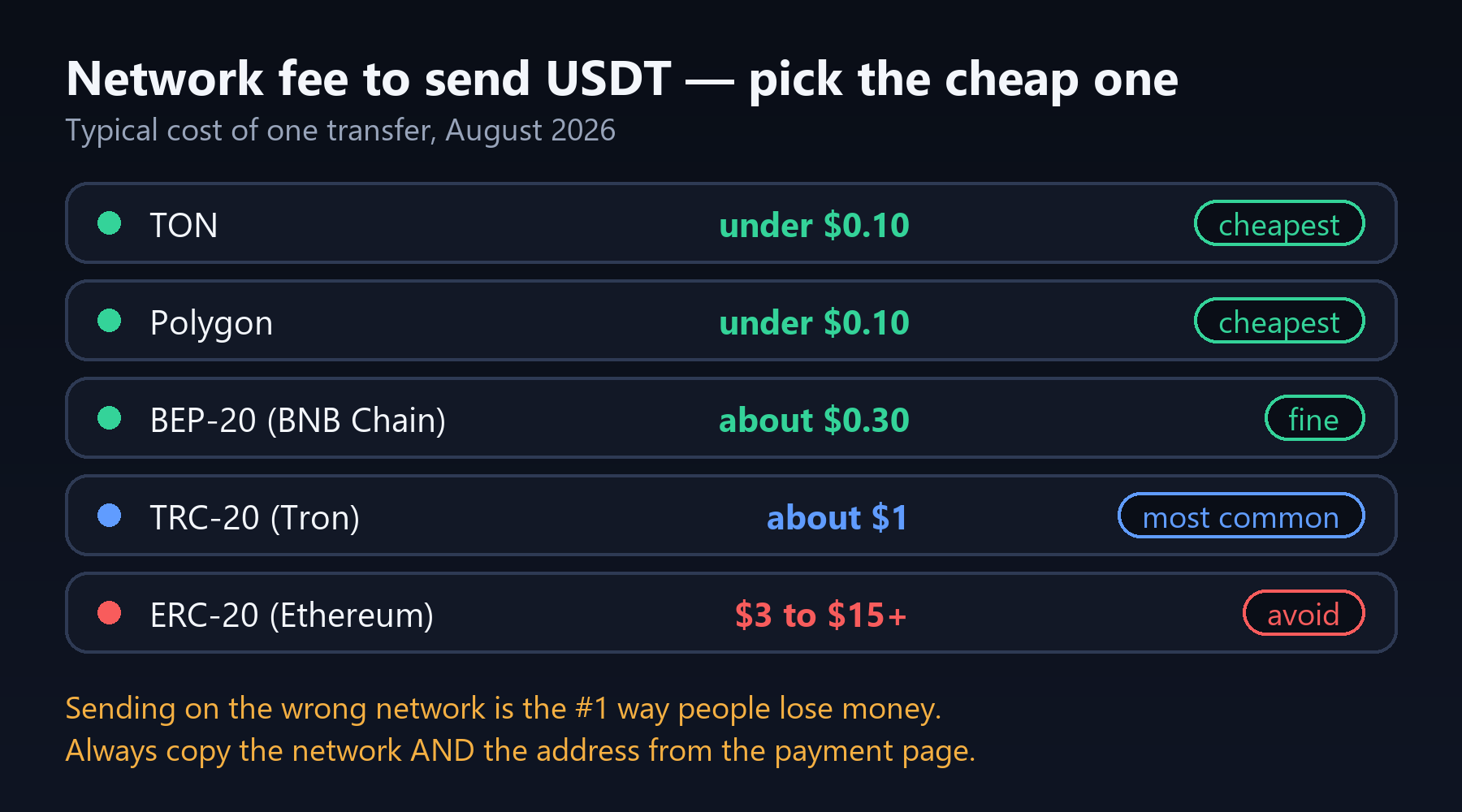

Two rules, and they are the whole section:
Match the network exactly. Copy the network and the address together from the payment page. USDT sent on ERC-20 to a TRC-20 address is usually gone permanently, and no support team can reverse it. This is the single most common way people lose money buying anything with crypto.
Check the fee before you send, not after. Paying a $9 Ethereum fee to move $10 of USDT is not a payment, it is a donation. If your wallet only offers ERC-20, move the balance to a cheaper network first or use an exchange withdrawal that lets you choose.
Paying inside Telegram, with no exchange at all
This is the route most people do not know exists, and for a lot of our buyers it is the best one. ProxyUniverse accepts payment through CryptoBot, which lives inside Telegram. You hold a balance in the bot, you pay from the chat, and the proxy is issued in the same app.
What that removes is significant: no exchange account, no identity verification for a $5 purchase, no withdrawal to an external wallet, no network selection to get wrong. If someone can send you USDT in Telegram, you can buy proxies. For buyers who have been blocked by exchange verification requirements, this is usually the answer.
On the site itself, payments run through Cryptomus, which covers Bitcoin, Ethereum, USDT and the other major coins with automatic crediting. Both routes land in the same balance and the same catalog.
How to get USDT where you are
The proxy purchase is the easy half. Getting coins in the first place is what actually stops people, and the answer is local rather than global.
Nigeria. P2P trading inside the big exchanges is the standard route: you pay a local seller in naira by bank transfer and receive USDT in the app. Naira volumes on P2P are among the highest in the world, so liquidity is not a problem at these amounts.
Bangladesh. P2P with bKash and Nagad payments is the common path. Amounts of $5 to $50 are routine and trades usually complete in minutes.
Pakistan and Egypt. Same P2P pattern with local bank transfer or wallet apps.
Iran and Venezuela. Local exchange desks and P2P groups, generally with a wider spread than the global rate. Compare two or three before committing.
Anywhere else. A regular exchange withdrawal, or a friend who already holds crypto. For a $10 purchase, borrowing $10 of USDT from someone you know is frequently the fastest option in existence.
One safety note that has nothing to do with us: on P2P, only release funds through the platform's escrow, never through a side channel, and be suspicious of any buyer or seller who wants to move the conversation off-platform. That advice is boring because it works.
The whole purchase, start to finish
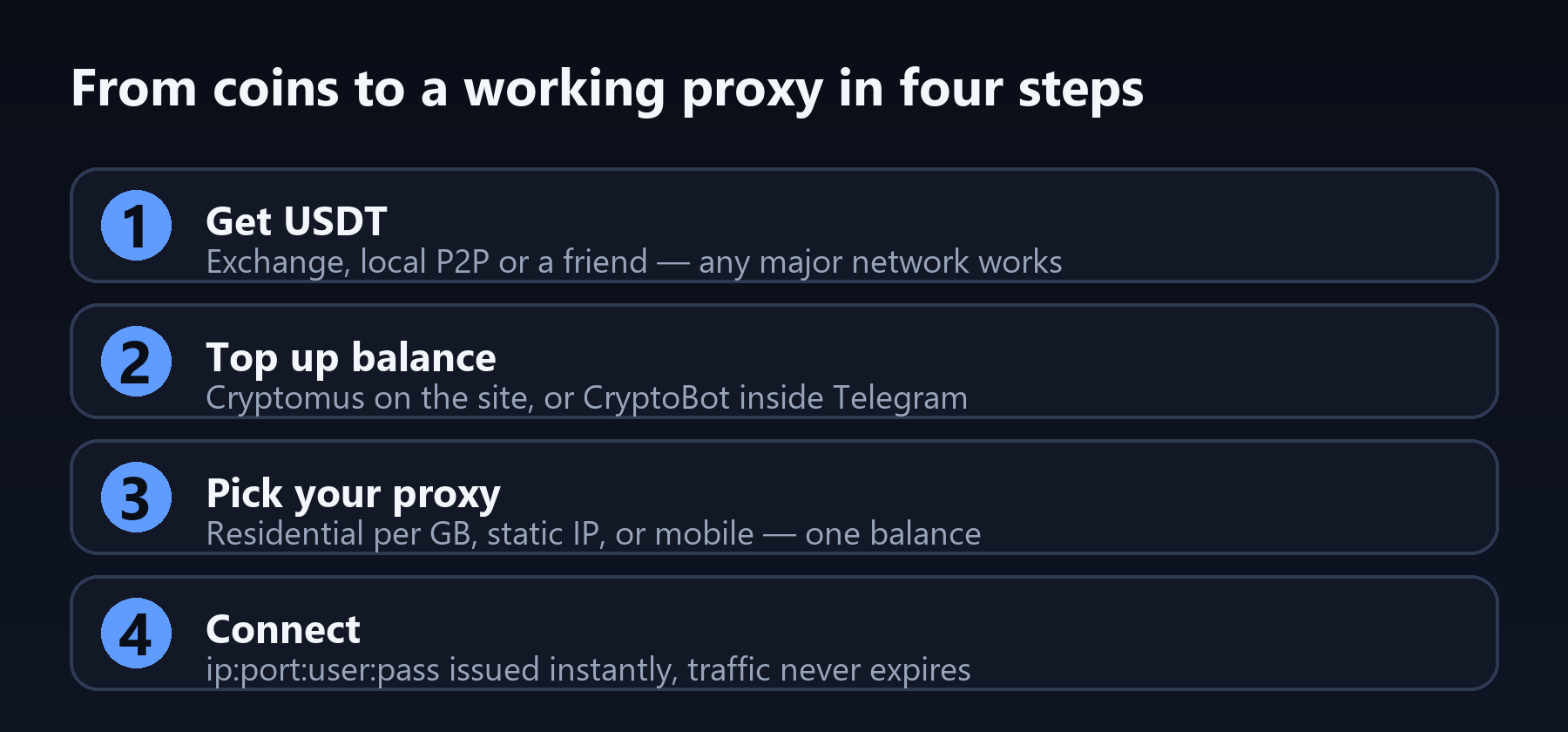

Get USDT through whichever local route above applies to you.
Top up your balance in the panel or through CryptoBot in Telegram. Minimum is $0.10, so you can test the flow with pocket change before committing real money.
Choose your proxy. Residential by the gigabyte, a static residential or ISP address by the month, mobile 4G/5G, or plain IPv4. One balance covers all of them, so you are not locked into the first thing you buy.
Connect. Credentials are issued immediately as
ip:port:user:pass, which works in any browser, phone or antidetect profile. Traffic on gigabyte plans does not expire, so a small first purchase is not a use-it-or-lose-it deadline.
Once you are connected, it is worth confirming what the new IP actually looks like from outside. Our free IP check and leak test shows the network type, whether any proxy headers are leaking, and whether WebRTC is exposing a second address.
Crypto versus cards, honestly
| Crypto (USDT / BTC / ETH) | Bank card |
|---|---|---|
Works from restricted countries | Yes | Frequently declined by the issuer |
Speed to credit | Seconds to a few minutes | Instant when it works |
Ties the purchase to your identity | No | Yes, on your statement |
Extra cost | Network fee, from under $0.10 | Possible cross-border and FX fees |
Mistakes are recoverable | No — wrong network means lost funds | Yes, chargebacks exist |
Setup needed first | A wallet or Telegram bot | None |
Neither is universally better. If you hold a working international card and privacy is not a concern, use the card. If your card gets declined, if you have no international card, or if you would rather not link your name to your infrastructure, crypto is not a workaround — it is simply the better instrument.
Mistakes worth avoiding
Sending on the wrong network. Said three times in this article because it accounts for most losses.
Paying a huge fee for a tiny order. Check the fee first; switch networks if it is a meaningful fraction of the purchase.
Using volatile coins for exact amounts. With BTC or ETH the value can drift between sending and confirmation. Stablecoins remove the problem.
Buying a large package first. With a $0.10 minimum there is no reason to. Buy one gigabyte, test it against your actual target site, then scale.
Trusting a "proxy seller" who only takes direct wallet transfers with no panel and no invoice. Automatic crediting through a real gateway exists precisely so you do not have to trust anyone by hand.
What this gets you
ProxyUniverse aggregates more than ten independent proxy networks behind one balance: rotating residential from $0.65 per gigabyte with non-expiring traffic, static residential and ISP addresses by the month, mobile 4G/5G, and IPv4. Crypto and cards both work, the minimum is ten cents, and there is no subscription to cancel.
Browse the proxy catalog — or take the small route first: top up a dollar, buy a gigabyte, and see how it holds up on the site you actually care about.
Questions and answers